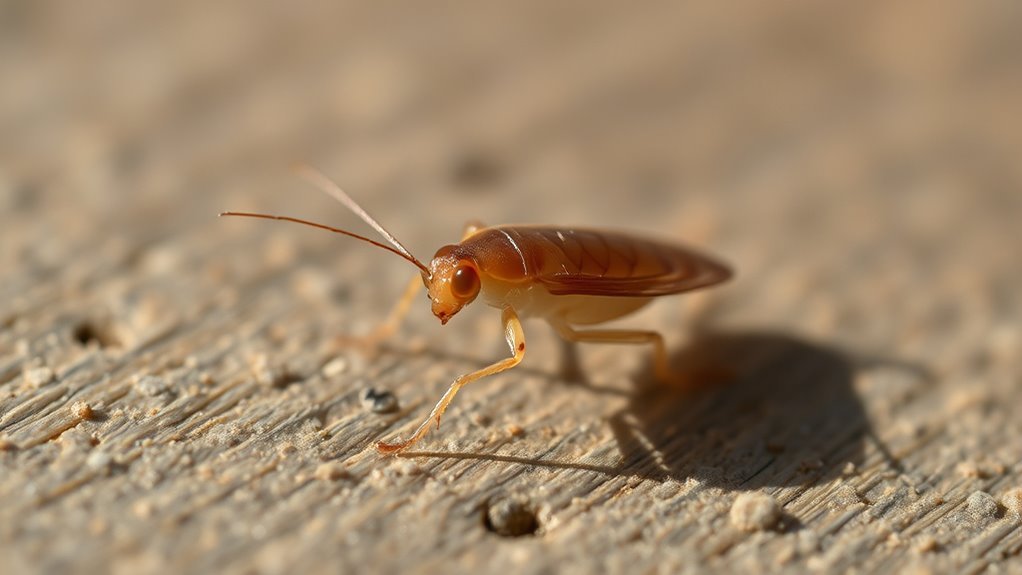
What Does a Baby Cockroach Look Like?
You’ll spot a baby cockroach by its small, flat, hard body and six spiny legs that help it move quickly.
Baby cockroaches, also called nymphs, start out white or light gray and then darken to shades of brown as they molt. These little critters may be tiny, but their appearance can tell you a lot about their species.
German cockroach nymphs are tiny and oval-shaped with dark stripes.
American cockroach babies are larger and reddish-brown, often with halos.
Oriental cockroach nymphs are the biggest of all and have banded patterns.
Curious about how their size and shape help you tell these species apart? Keep exploring this topic to learn more!
Key Takeaways
- Baby cockroaches, or nymphs, are small, flat, hard-bodied insects. They look like miniature adults but don’t have fully developed wings yet.
- When they first hatch, nymphs are white or light gray. As they grow and molt, their color darkens to various shades of brown.
- German cockroach nymphs are small and oval-shaped. They’re dark brown with parallel stripes and measure about 1/8 inch long.
- American cockroach nymphs are bigger and oblong. They have a reddish-brown color with distinctive halo markings and are about 1/4 inch long.
- Oriental cockroach nymphs are the largest among them. They’re oblong and reddish-brown with band patterns, ranging from 1/4 to 1/2 inch long.
Key Physical Traits of Baby Cockroaches
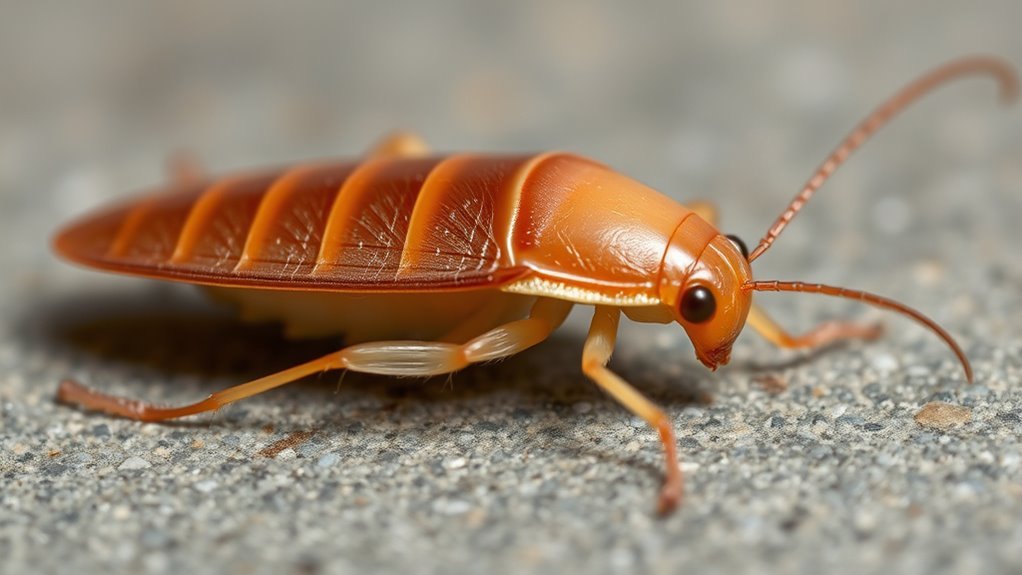
Baby cockroaches, also known as nymphs, are tiny creatures ranging from 1/8 to 1/4 inches long with flat, hard bodies that look like miniature adults. You’ll notice their physical traits include six spiny legs and a cylindrical body that helps them move quickly.
German cockroach nymphs tend to be smaller and oval-shaped, featuring dark brown parallel stripes. On the other hand, American cockroach nymphs are larger, oblong, and reddish-brown with distinctive markings.
Baby cockroaches start off white or light gray but darken to shades of dark brown as they molt and grow. One key feature is their underdeveloped wings—they don’t have fully formed wings until adulthood.
These sizes and traits help you recognize nymphs even before they mature. Pretty handy when you want to know what you’re dealing with early on!
How to Identify Baby Cockroaches by Species
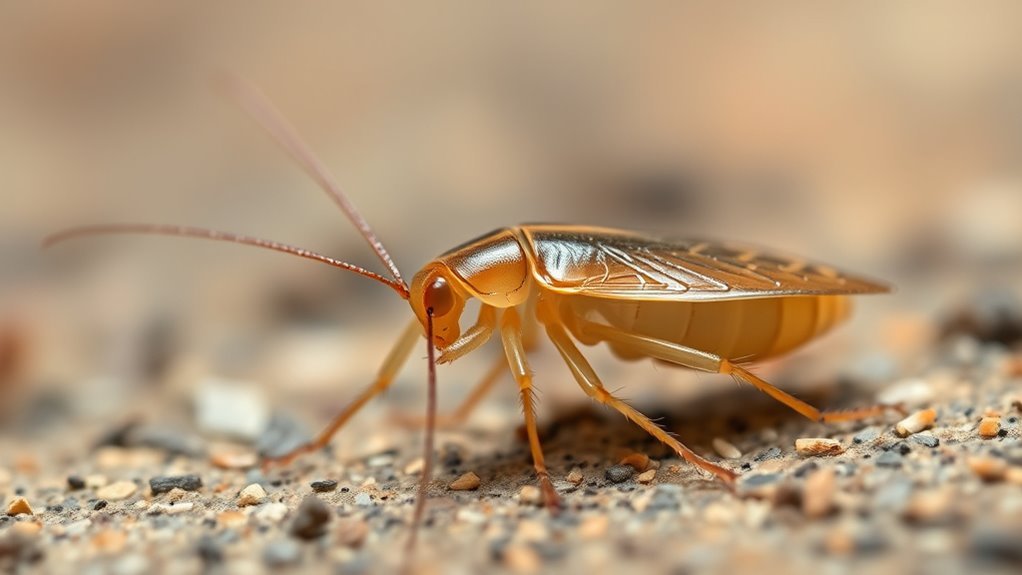
To identify baby cockroaches by species, you’ll want to focus on their size, shape, and coloration, as each type has distinct features. Baby German cockroaches are small, about 1/8 inch long, oval-shaped, and have dark parallel lines on a tan or light brown body.
Baby American cockroaches are larger, around 1/4 inch, oblong, and reddish-brown with a distinctive halo marking. Baby Oriental cockroaches range from 1/4 to 1/2 inch, are oblong, and display reddish-brown coloration with light and dark band patterns.
Newly hatched nymphs of all species start white or light grey and darken as they molt. So, by noting these differences in size, shape, and coloration, you can accurately identify the baby cockroach species you’re dealing with.
Frequently Asked Questions
How to Know if It’s a Baby Cockroach?
You’ll know it’s a baby cockroach if it’s small, wingless, and has a flat, hard body with long antennae. It’ll be lighter in color at first, darkening as it grows.
These little guys usually scurry near food or water. So, if you see something like that, it’s probably a baby cockroach.
What Can Be Mistaken for a Baby Roach?
You might mistake bed bugs for baby roaches since they’re close in size, but don’t judge a book by its cover—bed bugs are flatter and reddish, while baby roaches are cylindrical and brown with long antennae.
It’s easy to get them confused at first glance. But once you look a little closer, the differences really stand out.
What Does It Mean if I See a Small Roach?
If you see a small roach, it means an active nest is nearby, likely with adults and eggs. You shouldn’t ignore it—baby roaches multiply fast and indicate a growing infestation you’ll want to tackle immediately.
Seriously, even just one little roach is a red flag. It’s a sign there are probably more hiding out of sight. So, don’t wait around—take action as soon as you can.
Why Am I Seeing Tiny Baby Roaches?
You’re seeing tiny baby roaches because they’ve hatched nearby. They’re out searching for food and hiding in dark spots.
Basically, you’ve got a breeding site right there.
That means an infestation, and you need to act quickly before it gets worse.
Conclusion
Now that you know what baby cockroaches look like, you’ll spot them more easily. Did you know a single female cockroach can produce up to 400 offspring in her lifetime? That means those tiny nymphs you see could quickly multiply if left unchecked.
By recognizing their key traits and species differences, you can act fast to keep your space pest-free. Stay observant, and don’t let these little invaders catch you off guard!
Understanding what baby cockroaches look like is crucial for early detection and control. These nymphs might be small, but their numbers can grow rapidly, leading to a bigger infestation. So, keep an eye out for those tiny cockroach babies, and take action promptly to maintain a clean, pest-free environment. Being able to identify baby cockroaches helps you tackle the problem before it spirals out of control.